A 40-yard roll-off container holds approximately 240 standard 33-gallon trash bags or 14 to 16 level pickup truck loads of debris. This volume fits whole-house framing overhauls, commercial interior gutting, and…
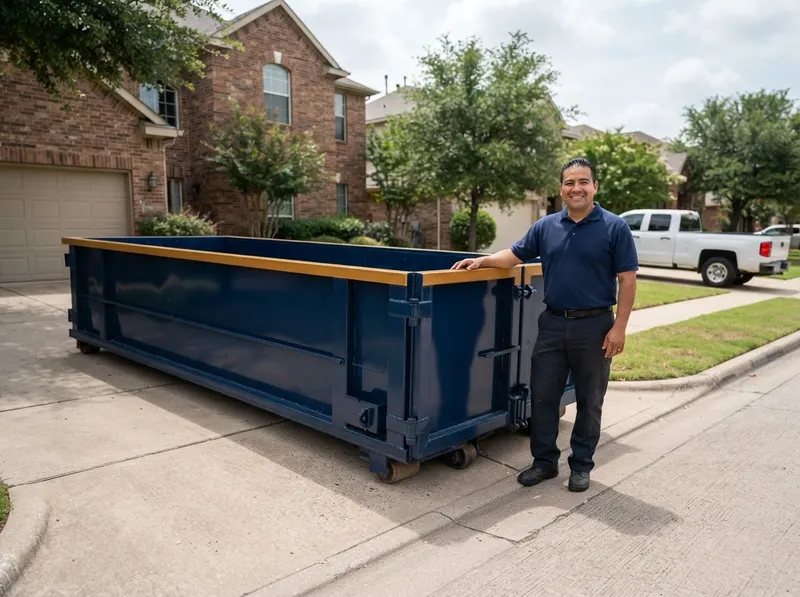
A 40-yard roll-off container holds approximately 240 standard 33-gallon trash bags or 14 to 16 level pickup truck loads of debris. This volume fits whole-house framing overhauls, commercial interior gutting, and multi-room estate clearing where small bins require expensive multi-trip swaps. In low-density residential subdivisions such as Kings Ridge and Deerfield, the unit takes up 22 feet of driveway length and 8 feet of width, equivalent to two standard passenger car parking spaces. The 8-foot side walls mean loading requires swinging open the rear barn doors to carry large items directly inside rather than lifting bulky waste over the edges. When setting up near established properties along Preston Road or Spring Creek Parkway, dispatch trucks require 60 feet of straight-line clearance and 23 feet of overhead clearance to hoist and drop the steel container without contacting tree limbs or utility wires.
Selecting container capacity requires balancing physical space against weight thresholds. While smaller options handle concentrated heavy materials like bathroom tile or dirt, high-volume demolition debris rapidly consumes physical capacity without necessarily hitting weight thresholds. Municipal disposal guidelines outlined by the City of Plano and safety parameters from the Occupational Safety and Health Administration govern how containers can sit on residential rights-of-way. In neighborhoods governed by restrictive covenants such as Avignon Windhaven and Willow Bend, placement must remain entirely on private concrete surfaces rather than streets to avoid local fines. Crews place wooden protective runners directly under the steel rollers to prevent surface gouges on stamped concrete and aggregate driveways. If debris includes items regulated under federal standards, property owners must divert them through the Environmental Protection Agency guidelines or municipal drop-offs rather than roll-off bins.
Regional waste handling in Collin County routes through designated transfer stations that adhere to recycling and solid waste standards maintained by the Texas Commission on Environmental Quality. Commercial contractors working near Legacy West or remodeling older ranches in Pitman Creek North frequently choose the 40-yard option because it minimizes dumpster downtime on tight job sites. To streamline residential operations, BluePeak Hauling monitors municipal guidelines from the Collin County administration and road transport criteria from the Texas Department of Transportation. For home additions requiring building permits, project managers must account for container footprint during site planning as referenced by the International Code Council. Specialized diversion of scrap metal and framing components aligns with technical salvage practices recognized by the American Society for Testing and Materials and national safety standards from the American National Standards Institute. Reusable architectural goods can be routed to diversion outlets verified by the National Recycling Coalition, keeping usable building products out of local municipal landfills.
Every job gets a firm, written price after a free on-site visit.
For standards, safe disposal, and service guidance on DUMPSTER in Plano, TX, useful references include U.S. EPA, EPA, EPA, OSHA, Earth911, and Google Maps. General consumer and small-business resources are available from USA.gov, Better Business Bureau, FTC Consumer Advice, U.S. Small Business Administration, and Ready.gov.
Tell us about your 40-yard dumpster rental job in Plano and we'll send a clear, written quote, usually the same day.
 BluePeak Hauling